Why Some Teams Excel While Others Collapse

I have worked with many different kinds of teams—some that I lead myself and others that I observed from a distance. In my experience working with different groups of people, I realized that what makes a team stand out isn’t the knowledge, expertise or skills of its people. Those things were important, but they didn’t decide which teams outperformed and which teams barely met my expectations.
All these teams had a good mix of people, clarity on their goals and the resources they needed to succeed. Yet, only a few groups consistently delivered while others struggled to keep up their commitments.
Teams that did well did not always succeed—what mattered more was not their success, but how they handled failures. Their ability to rise above the challenges came from their ability to take risks. Their sense of freedom enabled them to experiment and find unique solutions. They were quick to adapt new tools and processes—curious to learn new technologies and integrate them into their workflows. They did not rely on one individual to carry the team’s load, it was their collective effort that made them shine.
Great teams consist of individuals who have learned to trust each other. Over time, they have discovered each other’s strengths and weaknesses, enabling them to play as a coordinated whole.
— Amy Edmondson
While there are many small qualities that make a high-performing team, these 5 fall into a common pattern that always repeats:
Utilizing collective intelligence of the group as opposed to siloed thinking
Teams that do not come together to brainstorm on ideas miss out on diverse thinking and differences of opinion. When people in the group don’t seek feedback on their ideas or don’t invite critical review of their logic, they make decisions based on their own knowledge and beliefs. They fail to hear perspectives that can help them see the flaws in their thinking—assumptions that may not be true, challenges they did not anticipate, risks they might have ignored or a better way to achieve their goals.
Relying on individual knowledge as opposed to collective wisdom leads to poor choices and bad decisions—more work is required to fix mistakes that could have been avoided, more time is consumed in revisiting and rehashing old decisions and more energy is spent in trying to make a sub-optimal solution work.
Each person thinks differently and it’s this difference that adds value to the conversation. Every disagreement, every conflict, every question raised is an opportunity to align, resolve and converge on a common solution towards an approach that’s vetted and well thought out. A group of people can provide insights and expertise that no one individual can bring.
To become a team member who contributes towards collective intelligence, ask:
- How often do I involve others in my decision?
- What kind of feedback do I seek—validating my thoughts or contradicting them?
- Do I trust my team to give me the inputs I need?
- What value do I see in getting diverse opinions?
Teams that harness the power of collective intelligence are more innovative, better aligned and feel more supported—having others they can count on gives them the confidence to take the hard path and avoid easy choices.
In a complex world, isolated experts are a liability. What you need are networks of teams sharing real-time context and intelligence.
— Stanley McChrystal, Team of Teams
Teams excel when they count on each other to guide, support and learn. Their collective value exponentially exceeds what an individual member can achieve on their own.
Prioritizing team goals over individual needs
When each individual in the team cares only about themselves—their aspirations, growth, promotion and success—they put their own goals above everyone else. They lean towards tasks that will make them look good and help them get promoted. They refuse to do the grunt work even if that’s what their team needs. They don’t collaborate and co-operate to help their team succeed. Their support is conditional—subject to what they’ll gain from the transaction instead of doing it to help others without expecting anything in return.
Looking for opportunities to build new skills, taking on higher level roles and responsibilities or trying to stand out isn’t wrong. The problem occurs when individual aspirations start coloring their choices and impacting team goals. When everyone is thinking only for themselves, there is less alignment, more misunderstandings and confusion. Finger pointing and blame games start within team members as they try to protect themselves instead of taking responsibility.
When team members work with each other instead of working against each other, they achieve more as a group. They share knowledge, openly express their concerns, work out solutions to the obstacles in their path and align on a common direction forward. The shared camaraderie in facing challenges together also builds a strong bond which makes work feel more fun and less like a slog. It energizes the team to push themselves and face the challenges with more conviction and resilience.
To become a team member who puts team goals over individual needs, ask:
- Do I understand my team goals?
- How do my current goals fit into my team’s priorities?
- How can I help my team in achieving success?
- What can I learn from them?
When people in the team don’t separate their success from their team’s success, they achieve better results—being aligned on a common mission removes the friction that comes when everyone is rowing in a different direction.
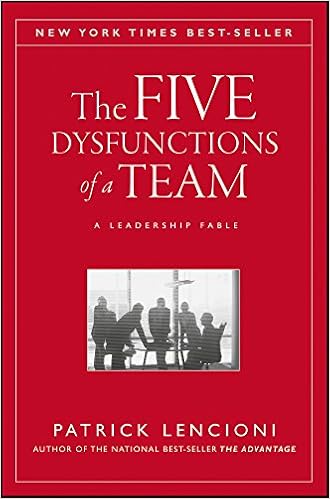
Inattention to results occurs when team members put their individual needs (such as ego, career development, or recognition) or even the needs of their divisions above the collective goals of the team.
— Patrick Lencioni, The Five Dysfunctions of a Team
Teams collapse when every member puts their own interests above team goals. Working together strengthens the team to push for bigger and better goals.
Feeling empowered to act independently without approval every step of the way
Teams that aren’t allowed to make their own decisions wait for approvals and permissions every step of the way. They need a higher level authority to review every minor detail, every small decision, every action they plan to take. They don’t feel confident about their decision. They worry about making a mistake. Being always dependent on someone else to make the final decision prevents them from taking accountability—they don’t feel responsible for how things turn out.
Forced dependency tremendously slows down the team. They are often blocked, waiting for someone up the hierarchy to validate. Things that could be achieved in a few hours take days and weeks. Not feeling empowered also demotivates the team—if they can’t be trusted with small decisions, they might never get the opportunity to take on bigger roles. Always having someone to correct them also prevents them from making mistakes and learning from the process—a key element to progress and grow at work.
Teams that understand which decisions they can make on their own and which require additional input excel as they can move fast on a large part of their work while slowing down for only a small fraction of it. Being trusted to lead decisions also creates the confidence and motivation to exceed expectations—when someone owns a decision, they’re more likely to stretch out and do everything possible to succeed. It creates a sense of accountability that’s otherwise missing.
To become a team member who can act independently, ask:
- What prevents you from making your own decisions?
- What’s the worst that can happen if your decision does not turn out the way you anticipated? What issues can you predict? What steps can you take to mitigate those risks? What action can you take if it still fails?
- What have you done to earn the trust to think and act independently?
- What are the gaps preventing you from being given this opportunity?
High-performing teams are built by individuals who realize that waiting for permission is a guaranteed way to fail. They demand trust, ownership and support to make their own decisions.
If you want people to think, give them intent, not instructions. Instructions breed compliance and dependence; intent breeds initiative and ownership.
— L. David Marquet, Turn the Ship Around!
Teams that can think and act on their feet will outperform those who are always waiting to make a perfect decision. Don’t surrender your agency. Stop being dependent.
Taking carefully evaluated risks without always playing it safe
When people in the team worry too much about failures and mistakes, they stop taking risks and start playing it safe. They do the work as it has always been done instead of identifying better ways. They give up on opportunities that require taking risks and sign up for the ones that feel safe. They hide mistakes instead of turning them into learning lessons. They don’t easily bounce back from failures as they treat even minor setbacks as major disasters.
Not taking risks keeps them locked in a cycle of mediocrity—working hard without being impactful. People in the team stop growing as they don’t push themselves beyond their comfort zone. They don’t build new skills. They don’t learn to navigate the uncharted territory. They don’t develop the thinking that’s required to tackle challenges. It eventually leads to frustration and a lack of motivation from being stuck in the same place for too long.
Instead of basing decisions on what feels safe, carefully evaluated risks enable team members to introduce better processes, practices and solutions. Embracing unknowns and uncertainty make work feel more exciting and enjoyable. Whether it’s choosing a risky strategy, taking bold steps or running small experiments, taking an unconventional path requires thinking above and beyond. It requires asking questions, challenging the status quo and refusing to take the easy path.
To become a team member who isn’t afraid of taking risks, ask:
- Am I leaning towards a safe choice only because the other option feels risky?
- Do I avoid going down the path with unknowns and uncertainties?
- What can I learn by pushing myself beyond my comfort zone?
- How can I stack the odds in my favor?
- What’s within my control?
- How can I take more risks?
Teams that make failure and feedback as part of their strategy invest in taking risks—they use a proper decision criteria to evaluate which risks are worth their time and attention.
If you aren’t making mistakes, you aren’t taking enough risks. And if you’re not taking enough risks, you’re not learning.
— John C. Maxwell, Failing Forward
Great teams aren’t risk averse. They treat obstacles in their path as a learning opportunity instead of a thing to avoid. They build the mental muscle to take risks with courage, experience and practice.
Leveraging AI to increase productivity and performance instead of resisting it
When team members do not invest in identifying how to apply artificial intelligence to their daily work, they take longer to complete tasks—something that could be done in a few minutes can take hours and even days. They might also make mistakes that could be easily flagged by an AI tool. They may miss critical insights or fail to see the flaw in their own thinking—something that ChatGPT, Google Gemini or Claude can easily point out when leveraged as a thinking partner. Their time and energy that can be better put to use in dealing with demanding and challenging tasks gets wasted by doing repetitive work manually instead of building workflows and delegating it to the AI agents.
Teams that don’t leverage AI can’t match the quality and pace of work of teams that make it a part of everything they do. Doing grunt work themselves prevents them from taking on higher level responsibilities. The number of people in the team itself becomes a limiting factor when AI is not treated as another teammate who can share your workload and help you become more productive and performant.
AI is really good at writing code, identifying bugs, summarizing content, doing analysis, generating insights, reviewing your approach and automating repetitive work. It can do all this without ever getting tired or complaining. It can free up your time to focus on things that only you can do—clarifying requirements, seeking alignment, validating and reviewing AI output and strategizing how to do more in less time.
To become a team member who uses AI to their advantage, ask:
- How can I partner with AI?
- What tools are available to me?
- What do I repeatedly do that can be accomplished using an AI agent?
- Which parts of my work should I continue doing myself and which parts should I delegate to AI?
When team members treat AI as their partner, they stop wasting their time and energy on tasks that are beneath their potential.
Within five years, the ability to work effectively with AI will be a standard expectation in most professional roles. Not because AI will replace human workers, but because AI-assisted workers will consistently outperform those who can’t harness these tools effectively.
― Enamul Haque, A Beginner’s Guide to Prompt Writing
AI will not replace human intelligence. It will enhance it. Teams that leverage AI will easily outpace those that resist it.
Summary
- Teams that skip the brainstorm and skip the feedback loop make decisions on incomplete knowledge. They miss the assumptions, risks and better paths that only come from other people’s eyes on the problem. Teams that invite disagreement instead of avoiding it end up more innovative, better aligned and more confident taking the harder path.
- When everyone optimizes for how they look instead of what the team needs, you get finger-pointing and misalignment instead of progress. When people stop separating their own success from the team’s success, the friction disappears and the whole group moves in one direction.
- Teams stuck waiting on permission for every small decision move slower, feel less accountable and never build the muscle to make bigger calls. Teams that know which decisions are theirs to own move fast on most of their work and only slow down where it actually matters.
- Playing it safe out of fear of failure keeps a team stuck in mediocrity—no growth, no new skills, no capacity for the unknown. Teams that treat risk and failure as strategy, not accident, are the ones that find better processes and better outcomes.
- Teams that don’t build AI into their daily work waste time on what could be done in minutes and miss the flaws AI could’ve flagged for free. Teams that treat AI like a teammate free themselves up for the work only a human can do and outpace everyone still doing it the old way.
Recommended Reading